Mint (Mentha spp.) is one of the most widely used aromatic herbs in Morocco, particularly for traditional tea, culinary applications, and the food industry. Hydroponic cultivation offers new opportunities to produce fresh mint with greater control over water management, nutrient delivery, and growing conditions.
DAELMED®, we explore how different hydroponic technologies can support sustainable mint production, from small-scale growing units to commercial greenhouse installations.
Why Grow Mint Hydroponically?
Mint is a vigorous perennial herb that can adapt well to soilless cultivation when its root-zone, nutritional, and environmental requirements are properly managed.
Hydroponic mint production offers several potential advantages:
- Efficient water management through appropriately designed irrigation and recirculation systems,
- Controlled nutrient delivery to support healthy vegetative growth,
- Optimized growing space through horizontal channels, growing beds, or vertical structures,
- Consistent production conditions through standardized cultivation and harvesting practices,
- Improved growing hygiene through proper sanitation and reduced direct contact with soil.
Exploring the Main Hydroponic Techniques for Mint
Different hydroponic systems can be used to cultivate mint. The most suitable solution depends on production capacity, available space, investment costs, maintenance requirements, and the intended market.
1. Nutrient Film Technique (NFT)
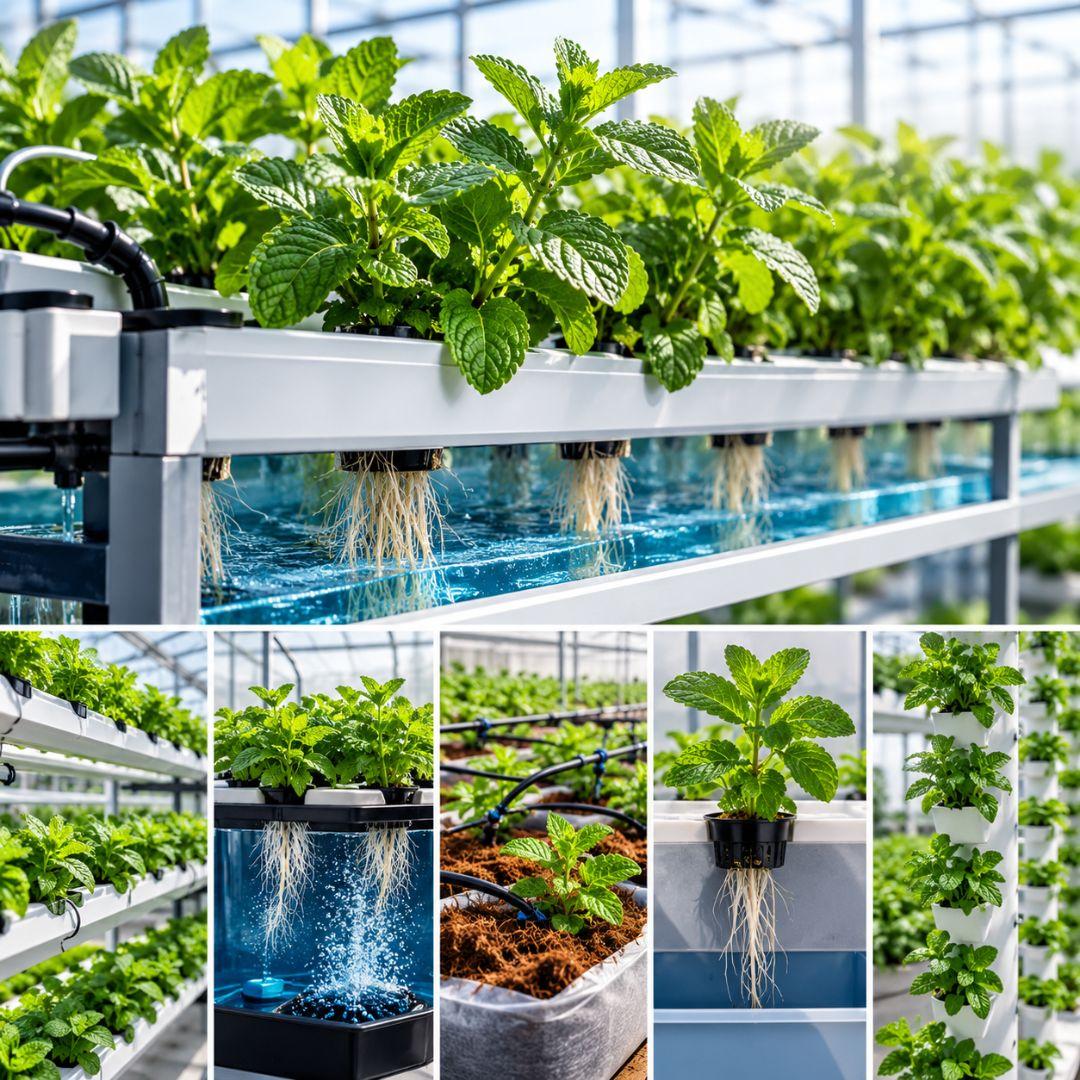
The Nutrient Film Technique (NFT) circulates a shallow stream of nutrient solution through slightly inclined channels. Mint plants are supported along the channels, allowing their roots to access water and dissolved nutrients.
- Advantages: Efficient nutrient solution circulation, organized plant spacing, and convenient harvesting.
- Applications: Modular greenhouse installations and commercial fresh mint production.
- Technical considerations: Mint roots can become dense and obstruct channels, making regular inspection and cleaning essential.
2. Deep Water Culture (DWC)
In Deep Water Culture (DWC), plants are supported above a reservoir while their roots extend into an aerated nutrient solution.
- Advantages: Simple system architecture and continuous access to water and nutrients.
- Applications: Small and medium-scale growing units designed for repeated harvesting.
- Technical considerations: Root-zone oxygenation, water temperature, nutrient concentration, and reservoir hygiene must be monitored.
3. Drip Hydroponics with Growing Substrates
In substrate-based hydroponics, mint is cultivated in materials such as coco coir, perlite, or expanded clay. A drip irrigation network delivers the nutrient solution directly to the root zone.
- Advantages: Flexible irrigation management, modular growing arrangements, and compatibility with greenhouse production.
- Applications: Commercial greenhouses and production units requiring adaptable growing configurations.
- Technical considerations: Irrigation frequency, substrate moisture, drainage, and root aeration require appropriate management.
4. Wick Hydroponics
Wick hydroponics uses an absorbent material to transfer nutrient solution from a reservoir to the growing medium through capillary action, without requiring a circulation pump for nutrient delivery.
- Advantages: Simple construction, low energy requirements, and limited mechanical complexity.
- Applications: Domestic cultivation, educational projects, and small growing units.
- Technical considerations: Passive nutrient delivery may be insufficient for vigorous mint plants with high water demand.
5. Aeroponics and Vertical Hydroponic Systems
Aeroponics delivers nutrient solution to suspended roots in the form of droplets or mist. Vertical hydroponic systems arrange growing positions across multiple levels to increase production density.
- Advantages: Efficient use of growing space, modular design, and opportunities for automation.
- Applications: Urban agriculture, space-constrained facilities, and advanced controlled-environment production.
- Technical considerations: Reliable irrigation, root health, light distribution, airflow, and equipment maintenance are essential.
Comparing Hydroponic Systems for Mint Production
Each technology offers different benefits and operational requirements. NFT and drip systems can be attractive for commercial greenhouse production, DWC offers an alternative based on an aerated nutrient reservoir, and wick systems are more suitable for simple, small-scale applications. Aeroponics and vertical configurations require careful evaluation of technical complexity and production objectives.
Nutrient Management and Growing Conditions
Successful hydroponic mint cultivation requires appropriate management of nutrient concentration, pH, water quality, temperature, light, and airflow.
- pH management: A preliminary range of approximately 5.5–6.5 can be used as a starting point for trials, subject to water quality and crop response.
- Nutrient management: Essential nutrients, including nitrogen, potassium, calcium, magnesium, and micronutrients, must be supplied in balanced proportions.
- Environmental control: Temperature, light intensity, ventilation, and shading influence vegetative growth and leaf quality.
- System hygiene: Reservoirs, channels, irrigation lines, and harvesting tools should be cleaned and maintained regularly.
From Small Growing Units to Commercial Greenhouses
Hydroponic mint production can be adapted to different scales, from domestic growing units and agricultural training projects to cooperative initiatives and commercial greenhouse installations.
Selecting the right system requires an assessment of available space, water quality, energy consumption, infrastructure costs, labor, maintenance, harvesting requirements, and market demand.
DAELMED®: Engineering Smarter Hydroponic Solutions
At DAELMED®, we combine hydroponic system design, technical integration, installation, and training to develop agricultural solutions adapted to real production needs.
Our approach focuses on combining efficient water management, appropriate growing technologies, operational reliability, and sustainable agricultural practices. For mint producers, the objective is to develop a growing system that supports plant health, product quality, and long-term economic feasibility.
In Morocco, where water management is an important agricultural challenge, well-designed hydroponic systems offer opportunities to explore more controlled and resource-efficient aromatic herb production.
DAELMED® – Engineering sustainable agriculture, one growing system at a time.
Discover our solutions and services at daelmed.ma.


 by SHIEH AZZOUZ